If 2023 was the year of "Wow, it can write poetry," and 2024 was the year of "How do we shove this into our sidebar?," then late 2025 has officially become the year of The Reality Check.
We spent two years treating AI like a very smart, very hallucination-prone intern that we kept trapped in a chat box. We asked it questions. We waited for answers. We copy-pasted those answers into emails.
That era is over.
With the late-November release of agent-native updates from major model providers (looking at you, Gemini 3 and GPT-5.1 Pro), the industry has pivoted hard. We are no longer building tools that talk; we are building agents that do.
Welcome to the era of Agentic AI. If your 2026 roadmap is still focused on "Generative AI" content creation, you are already solving yesterday’s problem. Here is why the shift from "Chat" to "Action" changes everything—from how we code to how we manage products.
The Technical Shift: RIP Prompt Engineering, Long Live "Context Engineering"
For the last two years, LinkedIn was flooded with "Top 10 Prompts to 10x Your Productivity." The underlying assumption was that the magic lay in the instruction.
In an Agentic world, the instruction is the easy part. The magic—and the difficulty—is in the Environment.
Generative AI is reactive. You prompt; it generates. It has no memory of yesterday and no access to your Jira board unless you paste it in.
Agentic AI is proactive. It loops. It plans. It has "hands" (API access) and "eyes" (browsing/computer use).
This demands a new discipline: Context Engineering.
If Prompt Engineering is like writing a perfect letter to a pen pal, Context Engineering is like urban planning for a digital employee. You aren't just telling the AI what to do; you are designing the office it works in.
- Permissions: Does this agent have read-only access to the database, or can it drop tables? (Please, God, read-only).
- Memory: Does it remember that User A prefers Python while User B prefers Rust?
- Tooling: When it hits a wall, does it have the right API keys to search for a solution, or does it just hallucinate an answer to save face?
We are moving from "RAG" (Retrieval-Augmented Generation) to Agentic Architectures—systems where the AI is the orchestrator, deciding which tools to use and when. It’s not about finding the right words anymore; it’s about building the right guardrails.
The PM Shift: "Vibe Coding" and The New Acceptance Criteria
For Product Managers, this is terrifying.
In 2024, if your AI chatbot hallucinated, the user just laughed and closed the window. In 2026, if your Supply Chain Agent "hallucinates," it might accidentally order 5,000 units of inventory because it "felt" like demand was rising.
Managing an Agent is less like managing software and more like managing a junior employee. This introduces a new layer of Product Management: AI Acceptance Criteria.
You can no longer just write: "As a user, I want to book a meeting."
You now have to write:
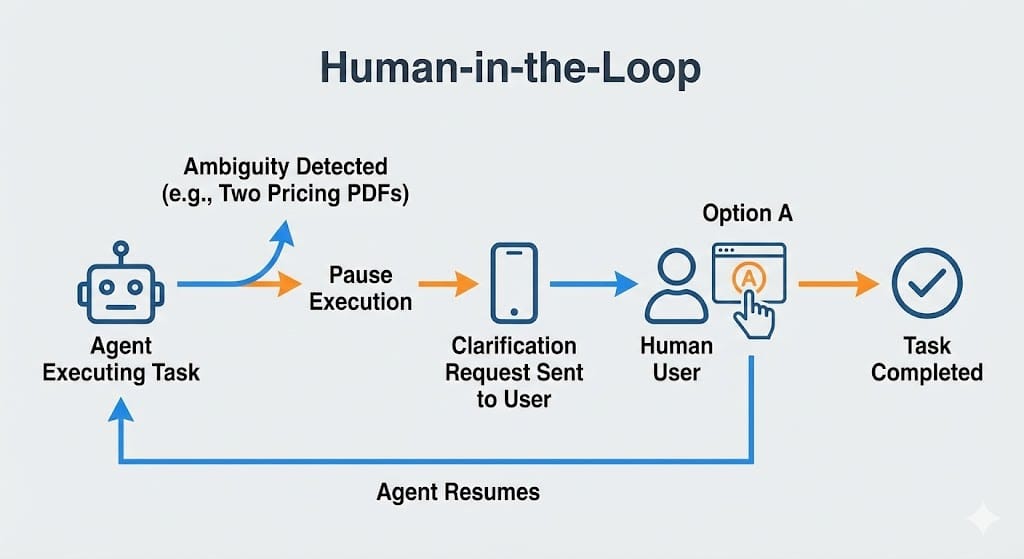
- What is the agent's confidence threshold before it sends the invite without human approval?
- If the agent encounters a conflict, does it reschedule or ask for help?
- What is the "Time-to-Panic" (the duration the agent tries to solve a problem before escalating to a human)?
We are also seeing the rise of "Vibe Coding"—where PMs and non-technical founders use agents to build working prototypes by describing the "vibe" and functionality, letting the agent handle the syntax. The "Full-Stack Product Manager" of 2026 isn't someone who knows React; it's someone who knows how to negotiate with an Agent to get the React code written correctly.
The Cultural Shift: From Co-Pilot to Team Member
The biggest friction point in 2026 won't be technical; it will be trust.
We are asking users to trust software not just to recommend an action, but to execute it. That is a massive psychological leap. The winning products of 2026 won't necessarily be the "smartest" ones, but the ones with the best transparency.
Users need to see the agent's "thought process." They need a "kill switch." They need to feel like the Pilot, even if the Autopilot is doing 99% of the flying.
The Bottom Line
If your AI strategy is still a sidebar that summarizes PDFs, you are building a legacy feature.
The future belongs to Agents—autonomous, context-aware, and action-oriented. The companies that win in 2026 will be the ones that figure out how to give these agents "hands" without letting them burn down the house.
Stop chatting. Start doing.
Next Week: The "Green" Data Reckoning—Why your AI's energy bill is about to become a Board-level issue.