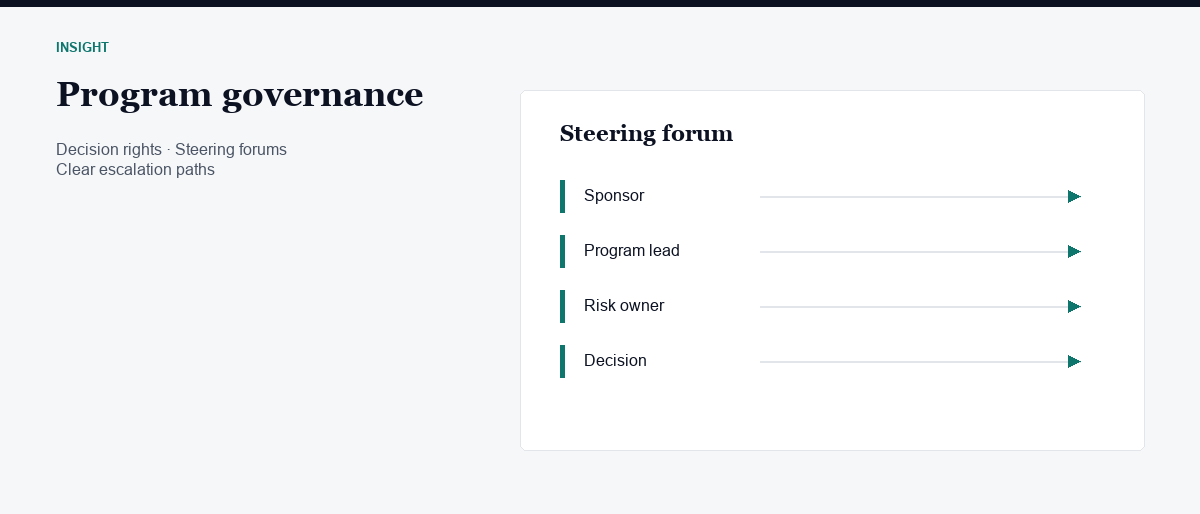
Program Management • Governance

Mastering Complexity: Program Governance, Steering Forums, and Clear Decision Rights for 2026

By Optimal Works Strategy Team • May 27, 2026 • 5 min read

In the evolving enterprise landscape of 2026, organizations face an unprecedented level of complexity in their strategic initiatives. Whether it's a large-scale digital transformation, a regulatory compliance overhaul, or the integration of new agentic AI capabilities, successful delivery hinges not just on technical prowess, but fundamentally on robust program governance. Without clear structures for decision-making and oversight, even the most promising programs can falter, leading to delays, cost overruns, and missed strategic objectives.

The Imperative of Robust Program Governance in 2026

The sheer scale and interconnectedness of modern enterprise programs demand more than traditional project management. Program governance provides the overarching framework to align initiatives with strategic objectives, manage interdependencies, allocate resources effectively, and ensure accountability. It’s the connective tissue that prevents strategic intent from dissolving into operational chaos. For Canadian enterprises navigating global shifts and domestic priorities, strong governance is not a luxury; it’s a strategic imperative for competitive advantage and risk mitigation.

Many organizations understand the concept but struggle with practical implementation. The symptom is often a feeling of 'death by committee,' where multiple stakeholders are involved but few decisions are made effectively. This paralysis stems from a lack of clarity around who owns which decision, what information is required, and what forums are truly empowered to act.

Defining Clear Decision Rights: The Cornerstone of Effective Delivery

Ambiguity in decision rights is a silent program killer. When stakeholders are unsure of their mandate, decisions are either escalated unnecessarily, delayed indefinitely, or worse, made inconsistently. This not only frustrates teams but also introduces significant risk and inefficiency into the program lifecycle. For complex initiatives, particularly those spanning multiple business units or involving significant capital investment, establishing a clear decision-making framework is paramount.

A well-defined decision rights matrix, often adapted from a RACI-P model (Responsible, Accountable, Consulted, Informed, Participant), clarifies roles and responsibilities at every level of the program. It outlines who has the authority to approve budgets, scope changes, resource allocations, and major risks. This transparency empowers teams to make decisions at the lowest appropriate level, accelerating progress while maintaining strategic oversight.

  • Responsible: The individual(s) who do the work to complete the task.
  • Accountable: The one person ultimately answerable for the correct and thorough completion of the deliverable or task.
  • Consulted: Those whose opinions are sought, typically subject matter experts. This is a two-way communication.
  • Informed: Those who are kept up-to-date on progress and decisions. This is a one-way communication.
  • Participant (P): An optional addition, indicating active involvement in a task, without being solely Responsible or Accountable.

Implementing such a matrix requires upfront effort and ongoing discipline, but the return on investment in terms of speed, clarity, and reduced rework is substantial.

Steering Forums That Actually Steer

Program steering committees or forums are often the public face of program governance. Yet, their effectiveness varies wildly. Too often, they devolve into glorified status report meetings, failing to address critical impediments or make timely strategic decisions. An effective steering forum is a strategic asset, not an administrative burden.

Key Attributes of an Effective Steering Forum:

  • Clear Mandate and Charter: The forum must have a formally defined purpose, scope, and decision-making authority. This includes what decisions they *can* make and what decisions need to be escalated further.
  • Right Composition: Members should be senior leaders with sufficient authority, domain expertise, and a direct stake in the program's success. Avoid large, unwieldy groups; focus on those who can genuinely contribute to strategic guidance and problem-solving.
  • Focused Agendas: Meetings should prioritize strategic discussions, critical risks, major issues requiring escalation, and key decisions. Status updates should be pre-read material, allowing meeting time for debate and resolution.
  • Pre-read Materials and Preparation: Members must receive concise, high-quality pre-read materials well in advance, detailing key decisions required, options, and recommendations. This ensures informed discussion.
  • Action-Oriented Outcomes: Every meeting must conclude with clear decisions, assigned actions, and defined owners and deadlines. Minutes should reflect these outcomes accurately and be circulated promptly.

By transforming steering forums into true decision-making bodies, organizations can significantly accelerate program delivery and maintain strategic alignment.

Establishing Robust Governance Structures: Beyond the Basics

Beyond decision rights and steering forums, a comprehensive program governance framework includes several other critical components:

  • Program Charter: A foundational document outlining the program's objectives, scope, key deliverables, success metrics, and high-level governance structure.
  • Risk and Issue Management Framework: Clearly defined processes for identifying, assessing, mitigating, and escalating program risks and issues. This must integrate seamlessly with decision rights.
  • Change Control Process: A structured approach to managing scope, budget, and schedule changes, ensuring all modifications are properly evaluated, approved, and communicated.
  • Performance Reporting and Metrics: Regular, objective reporting on program progress against established baselines, focusing on key performance indicators (KPIs) relevant to strategic outcomes.
  • Stakeholder Engagement Strategy: A plan for identifying, analyzing, and engaging all key stakeholders throughout the program lifecycle to manage expectations and secure buy-in.

These elements, when integrated effectively, create a transparent and accountable environment where programs can thrive amidst complexity.


Actionable Takeaways for Your Organization:

  1. Map Your Decision Rights: For your next complex initiative, go beyond generic role descriptions. Develop a detailed decision rights matrix (e.g., RACI-P) for key program activities and deliverables. Socialize it widely and enforce it rigorously. This clarity alone can unlock significant efficiencies.
  2. Re-evaluate Your Steering Forum's Mandate: Review the charter and recent meeting minutes of your primary program steering committee. Is it truly empowered to make critical decisions, or is it primarily an information-sharing body? Challenge its composition, agenda, and pre-read requirements to ensure it functions as a strategic decision engine.
  3. Integrate Governance with Risk Management: Ensure your program’s risk and issue management processes are directly linked to your governance structure. Who reviews critical risks? Who has the authority to approve mitigation strategies or escalate significant threats? Clear pathways prevent surprises and enable proactive response.

How Optimal Works Helps Your Organization Succeed

At Optimal Works, we understand that establishing and maintaining effective program governance requires a blend of strategic insight, practical experience, and change management expertise. Our advisory services focus on helping Canadian enterprises design and implement robust governance frameworks tailored to their unique organizational context and the specific demands of their complex initiatives. We partner with clients to:

  • Assess Current Governance Maturity: Identify gaps and areas for improvement in existing program oversight.
  • Design Bespoke Governance Models: Develop tailored frameworks, including decision rights matrices, steering committee charters, and escalation protocols, that align with strategic objectives.
  • Implement and Embed Best Practices: Guide organizations through the practical application of governance principles, ensuring they are adopted effectively by all stakeholders.
  • Facilitate Steering Forum Effectiveness: Coach leadership and program teams on running high-impact steering committee meetings that drive timely and informed decisions.
  • Enhance Program Delivery Excellence: Provide ongoing support to ensure governance structures enable, rather than impede, program success, ultimately delivering tangible business value.

By strengthening your program governance, Optimal Works empowers your organization to navigate complexity with confidence, accelerate delivery, and achieve superior outcomes for your most critical strategic initiatives.

Discuss this with your team

Optimal Consulting helps enterprises deliver on Project & program management—from strategy through execution.

Book a consultation